Government advocacy delivers major health and safety law reform win
ACAT has worked for years to change unclear workplace health and safety laws that raised liability concerns for landowners and inadvertently restricted people’s ability to access crags and other recreation opportunities. That work has now paid off in full.
ACAT has worked for years to change unclear workplace health and safety laws that raised liability concerns for landowners and inadvertently restricted people’s ability to access crags and other recreation opportunities. That work has now paid off in full.
The recently passed Health and Safety at Work Amendment Act contains a specific exception for recreational access. Once the Act comes into force early next year, landowners and land managers can be confident that they will have no risk of liability for any recreation-related accident on their land, unless the accident results from their own work.
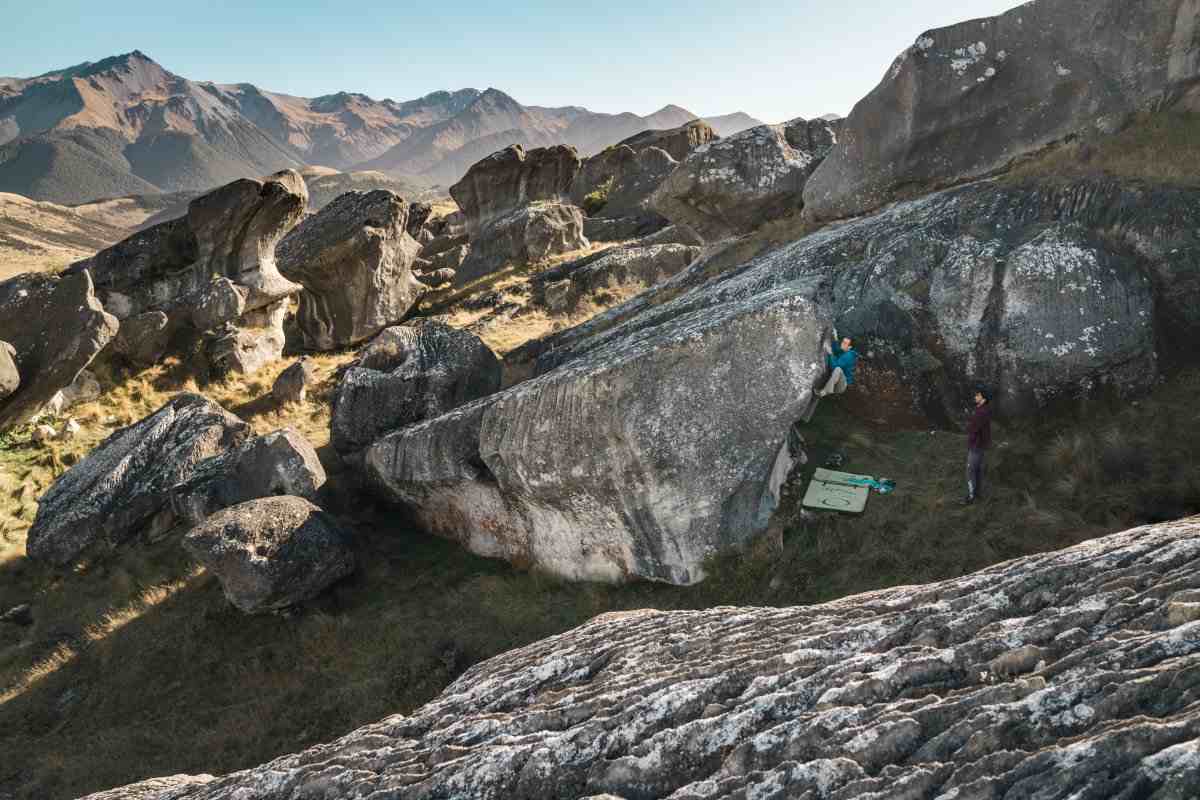
Stu Kurth at Flock Hill. Photo: Tom Hoyle.
This is a major win for climbers and alpinists, but also trampers, hunters, mountain bikers and anyone else who love getting outdoors. ACAT has worked closely with the Federated Mountain Clubs (FMC), NZAC and many other organisations to secure this win.
Outdoor activities cannot be made risk-free. The cliffs and natural features that we climb on present risks that are an inherent part of climbing and these should be managed by those who choose to participate. But that principle has been challenged in recent years, including by New Zealand’s previous Health and Safety law.
Removing the fear of liability
Under the previous law, landowners including farmers, foresters and councils, faced uncertainty about whether allowing recreational users onto their land could expose them to prosecution or liability. This lack of clarity led to multiple crag closures, most notably the Auckland Grammar School quarry in 2017.
Landowner concerns intensified further when WorkSafe took health and safety prosecutions after the 2019 Whakaari/White Island tragedy.
ACAT has spent five years taking legal and political action to fix the law. Our view has always been that climbers take personal responsibility for their safety, and any recreational accidents should not be the concern of the landowners who generously provide access to their land, nor of ‘workplace’ health and safety laws.
How we did it
ACAT successfully intervened in the Whakaari High Court proceedings, ensuring that the judge was aware of the case’s relevance for wider recreational access. The judge agreed with our submissions and found that the landowners were not responsible for recreational activities on ‘bare land’.
In 2024 ACAT also started a government advocacy campaign for comprehensive law reform, pioneering a joint recreation-sector coalition to increase our impact. We worked in partnership with FMC to create a powerful call for legal reform and gain national media coverage and political attention.
Representing the wider coalition of 12 leading organisations, FMC and ACAT worked extensively with Health and Safety Minister Brooke van Velden and government officials throughout the review process. The coalition also lodged a joint submission and presented oral submissions to the select committee. Together we achieved a sensible law change that will safeguard outdoor access for future generations.
What the new law says
Once the new law comes into force next year, landowners and land managers, referred to in the Act as anyone "conducting a business or undertaking, who manages or controls a workplace that includes outdoor space", will no longer owe workplace management duties to people using that land for recreation, including those crossing it to reach other land.
The only exceptions are where the recreational activity is part of the landowner’s business (e.g. commercial guiding), or where work is being carried out at the same time and near the place used for recreation. Access fees for entering the outdoor space do not make the activities part of the landowner’s business.
The Act restores a principled distinction: work is work, and recreation is recreation. For the first time in a decade, we have complete clarity that NZ’s workplace health and safety laws do not apply to non-commercial recreation.
The work continues
ACAT and FMC are continuing to work together and with officials on the guidance that will sit beneath the new law as well as clarifying the HSWA position for clubs. This is a great example of what effective co-operation between government and civil society looks like: working alongside the wider outdoor community, proposing a positive and workable solution, and securing what ought to be durable law changes.
ACAT will also be working hard to help educate climbers and landowners about the law change, making long-term crag access more durable and aiming to potentially reopen crags.